
Metal Pipe Elbow Manufacturer in the USA
- Home
- metal pipe elbow
Metal Pipe Elbow Manufacturer in the USA
Pipe Elbow Configurations We Supply
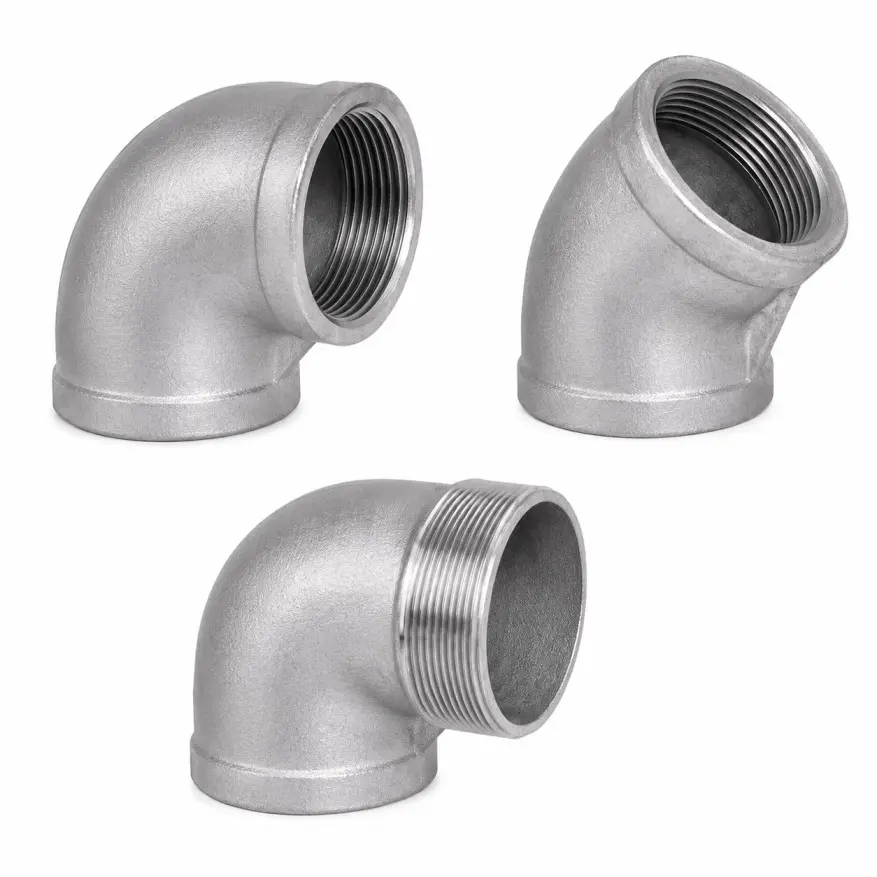
45° Pipe Elbow
90° Pipe Elbow
180° Pipe Elbow (Return Bend)
Long Radius Elbow (LR — 1.5D)
Short Radius Elbow (SR — 1D)
Extended Radius Elbows (3D / 5D / 10D)
Heat Treatment & Mechanical Enhancement
- Seamless formed elbow : hot-formed over a mandrel from seamless pipe, delivering maximum structural integrity with no longitudinal weld seam, preferred for high-pressure and critical-service installations
- Welded elbow : formed from electric-resistance-welded (ERW) or submerged-arc-welded (SAW) pipe, cost-effective for moderate-pressure and general-service applications
- Forged elbow: manufactured by die-forging a heated billet, producing dense grain structure and superior mechanical properties for wellhead assemblies, high-pressure hydraulic systems, and critical steam piping
- Fabricated (mitered) elbow : assembled by cutting pipe segments at calculated miter angles and welding them together, used for large-bore elbows exceeding standard forming capacity and non-standard angle requirements
- Induction bent elbow : produced by feeding straight pipe through an electromagnetic induction coil while mechanically bending to a precise radius, the preferred method for large-diameter pipeline elbows requiring tight geometric control
Pipe Elbow Materials and Grades
Carbon Steel
ASTM A234 WPB and WPC (general industrial service), ASTM A420 WPL6 (low-temperature service to -50°F), API 5L pipeline grades (Grade B through X80). Carbon steel elbows constitute the largest share of industrial elbow consumption in the United States — installed across oil and gas, water infrastructure, structural, and general mechanical piping systems.
Stainless Steel
ASTM A403 WP304, WP304L, WP316, WP316L, WP321, WP347, WP310S. Specified wherever the service environment demands corrosion resistance, oxidation resistance, or hygienic surface properties — petrochemical process piping, pharmaceutical utilities, food-grade transfer systems, desalination, and marine piping.
Alloy Steel (Chrome-Moly)
ASTM A234 WP5, WP9, WP11, WP22, WP91. Engineered for elevated-temperature service in power generation boiler piping, refinery high-temperature process lines, superheater connections, and steam header systems operating above 800°F.
Duplex and Super Duplex Stainless Steel
UNS S31803 (2205) and UNS S32750 (2507). High-strength, corrosion-resistant grades for offshore platform topsides, subsea piping, chemical processing, and desalination systems.
Low-Temperature Carbon Steel
ASTM A420 WPL6. Certified for cryogenic service at LNG terminals, cold-storage facilities, and low-temperature pipeline applications.
Aluminum
ASTM B361 WP6061. Lightweight, corrosion-resistant elbows for marine vessel piping, instrumentation tubing, and specialty chemical systems where ferrous materials are unsuitable.
Technical Specifications
| Parameter | Details |
|---|---|
| Material Grades | ASTM A234, A403, A420, B361, API 5L |
| Applicable Standards | ASME B16.9, ASME B16.28, MSS SP-75 |
| Bend Angles | 45°, 90°, 180° (custom angles on request) |
| Bend Radius | Long radius (1.5D), Short radius (1D), 3D, 5D, 10D |
| Size Range | NPS 1/2" through 48" (larger via fabrication or induction bending) |
| Schedule / Wall | SCH 5 through SCH 160, XXS |
| End Preparation | Buttweld (BW), Socket weld (SW) |
| Surface Condition | As-formed, shot blasted, coated, galvanized, pickled & passivated |
| Manufacturing Methods | Seamless, welded, forged, fabricated (mitered), induction bent |
| Testing Capability | Hydrostatic, PMI, UT, RT, MT, PT, HIC, NACE MR0175 |
| Documentation | CMTR (EN 10204 3.1), dimensional reports, test certificates |
How Pipe Elbows Are Manufactured
Mandrel Hot Forming
The predominant production method for standard-size seamless and welded pipe elbows. A straight pipe section is heated to forming temperature in a furnace and pushed over a horn-shaped internal mandrel that expands and shapes the pipe into the target angle and radius. Post-forming operations include heat treatment, end beveling, and dimensional verification. This method covers NPS 1/2" through approximately 24".
Induction Bending
The standard method for large-diameter pipeline elbows. Straight pipe passes through a localized induction heating coil that raises a narrow circumferential band to forming temperature (1,650°F–2,100°F) while a CNC-controlled swing arm bends the heated zone to the specified radius. Induction bending delivers tight geometric control with minimal wall thinning — making it the default choice for oil and gas transmission lines, LNG terminal piping, and large-bore industrial systems.
Die Forging
A heated steel billet is pressed or hammered into a closed die cavity to produce the elbow shape in a single operation. Forging generates a dense, grain-refined microstructure with superior impact toughness and fatigue resistance. Forged elbows serve the highest-pressure applications — wellhead assemblies, hydraulic manifolds, high-pressure steam piping, and critical-service industrial systems.
Miter Fabrication
For very large bore elbows exceeding standard formed sizes — or non-standard angles not available as catalogue fittings — individual pipe segments are precision-cut at calculated miter angles and welded together to form the elbow geometry. Fabricated miter elbows are standard practice in power plant ducting, large-bore process piping, heavy industrial exhaust systems, and structural piping where formed fittings simply do not exist in the required size.
Industries Served Across the United States
Get Industrial-Grade Metal Pipe Elbows for Your Next Project
Submit your details
- Material grade and ASTM/API specification
- NPS size and schedule
- Elbow angle — 45°, 90°, 180°, or custom
- Bend radius — long radius, short radius, or extended (3D/5D/10D)
- Quantity and project timeline
- Required testing and documentation
Why Choose TYA for Metal Pipe Elbows?
- Houston, Texas-Based Manufacturer — US support and logistics
- Full ASTM and API Material Coverage — carbon steel through duplex stainless
- NPS 1/2" to 48"+ — standard and custom large-bore sizes
- ASME B16.9 and ASME B16.28 Compliant — dimensionally verified
- Seamless, Forged, Fabricated, and Induction Bent Options
- Full CMTR and Test Documentation on Every Order
- ISO 9001 Certified Manufacturing
- Fast RFQ Turnaround — Specifications to Quote in 48 Hours
FAQ for Customer
- An induction bent elbow is manufactured by passing straight pipe through an electromagnetic induction heating coil while bending it to the specified radius using a CNC-controlled swing arm. This method produces large-diameter pipeline elbows with precise geometry and minimal wall distortion.
- A fabricated miter elbow is assembled by cutting pipe segments at calculated angles and welding them together to form the required elbow geometry. Miter elbows are used for very large bore sizes and non-standard angles where formed or forged fittings are not available.
- Every order ships with Certified Material Test Reports (CMTR per EN 10204 3.1), dimensional inspection reports, and applicable test certificates including hydrostatic, PMI, UT, RT, and HIC as specified by the project requirements.
- Yes. TYA is headquartered in Houston, Texas, and supplies pipe elbows to pipeline contractors, EPC firms, fabrication shops, and industrial buyers across the entire United States.
- Yes. TYA manufactures custom pipe elbows including non-standard angles, extended radii, oversized diameters, special wall thicknesses, and material grades outside standard catalogue offerings. Share your drawing or specification for a quotation.
- Submit your material grade, NPS size, schedule, angle, radius, quantity, and applicable standards via the Get In Touch form or contact TYA directly at contact@tyallc.com or +1.281.949.6123.